Guide

Family History Interview Questions

Every family has stories that live in only one person's memory. This guide walks through the free Relative Interview Question Set: an 11-page booklet of 48 questions across 8 themes for capturing a relative's life story in their own words, whether you record one long conversation or spread it across several visits.

48 questions across 8 themes, from childhood memories to the wisdom they want to pass on.

A free 11-page PDF you can fill in digitally or print and complete by hand.

Pairs naturally with DNA research: a story from an interview often explains a match cluster you couldn't place.

Free Relative Interview Question Set

This template gives you 48 questions across 8 themes, from childhood through the wisdom they'd pass on, plus room to write down what you learn as you go. It works for one long sitting or several shorter visits, and it's built to be filled in digitally or printed and completed by hand.

Free PDF template

Relative Interview Question Set

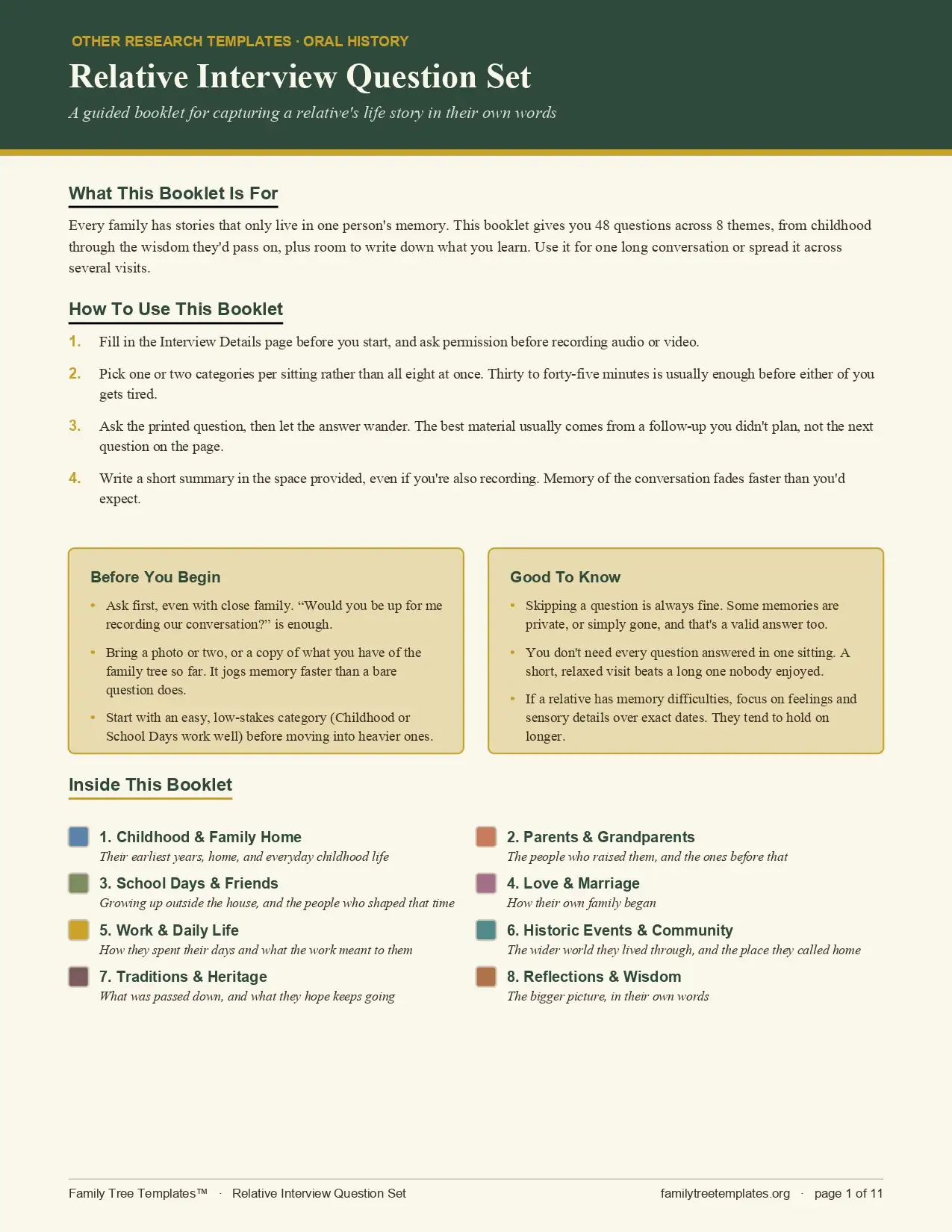
A guided booklet for capturing a relative's life story in their own words, with an Interview Details page, 8 themed question pages, and a closing Session Log for tracking follow-up visits.

Download free PDF template

The template is a practical tool for capturing memories. It doesn't replace verifying names, dates, and places against records afterward.
Why it matters

Why family history interviews matter

Records can tell you when someone was born or who they married. They rarely tell you what their childhood home smelled like, why a nickname stuck, or what advice they'd give their grandchildren. That kind of detail only exists in a living memory, and it disappears with the person who holds it.

The hard part usually isn't wanting to ask. It's knowing where to start, how long to go, and what to do with the answers afterward. A structured set of questions removes the guesswork, so the conversation can do the work instead of the planning.

This template groups questions into 8 themes so you can start light and go deeper only when it makes sense, rather than opening with 'tell me your life story' and watching the conversation stall.

If you're new to genealogy generally, it can help to establish your basic family structure first. Our Genealogy for Beginners guide covers the broader process of starting family-history research.

How to use the template

1. Fill out interview details first

Record the name, relationship, birthplace, and interview date and location. Note which format you're using, and get a spoken or written yes before you record anything, even with close family.

2. Read "Before You Begin" first

Bring a photo or two if you have them. They jog memory faster than a question on its own. Start with an easier theme, Childhood or School Days work well, before moving into heavier ones.

3. Pick one or two themes per sitting

There are 8 themes and 48 questions total, so most interviews take several visits. Thirty to forty-five minutes is usually the point where either person starts to fade.

4. Let the conversation wander

Ask the printed question, then follow where the answer goes. Treat the questions as a starting point, not a script to stick to rigidly.

5. Write a short answer as you go

Fill in the answer box under each question, even briefly, even if you're also recording. A short written summary holds up over time better than memory of the conversation does.

6. Skip what needs skipping

Some memories are private or simply gone. That's a valid answer, not a gap you need to fill.

7. Use the closing page afterward

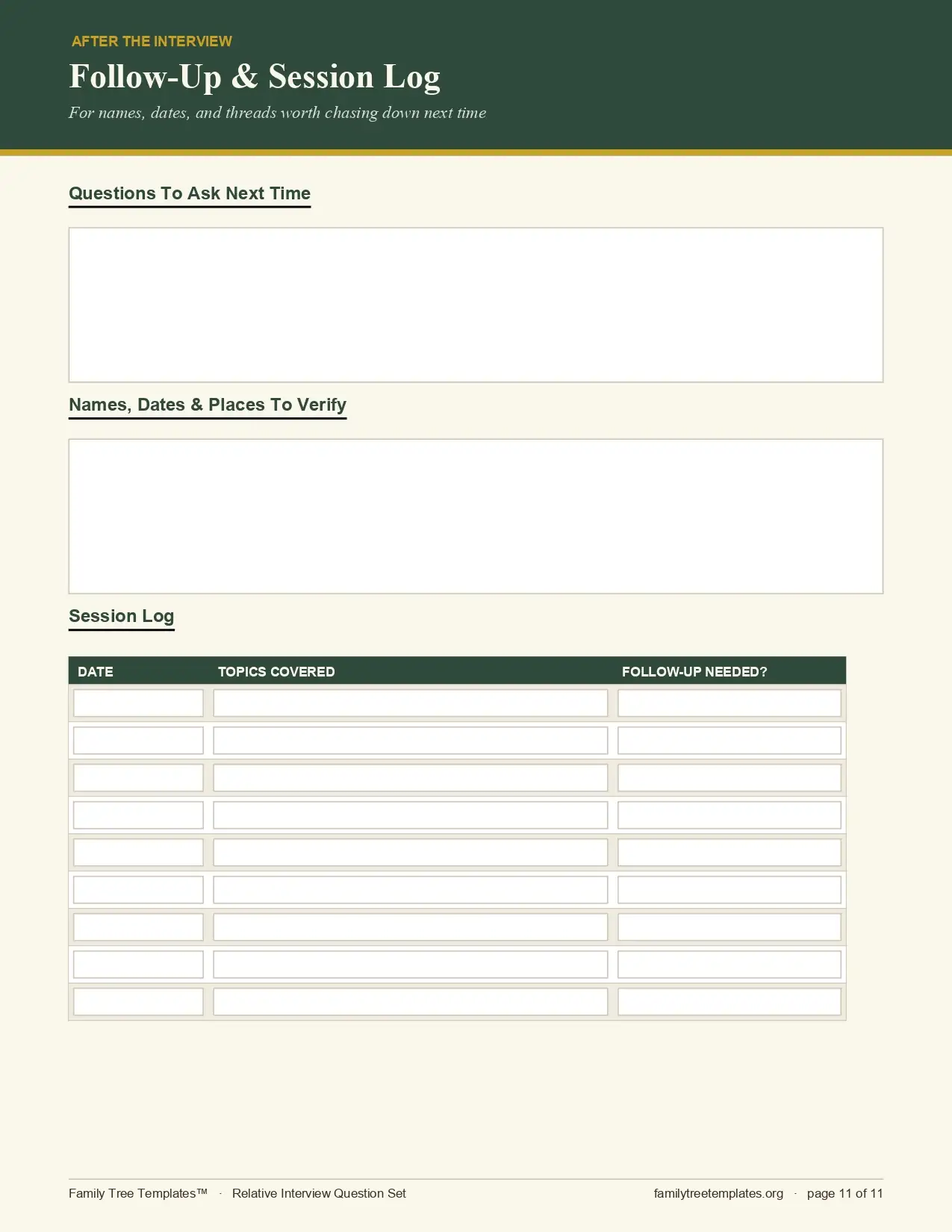
Note any questions you want to come back to next time, and any names, dates, or places mentioned that you'll want to verify against records later.

8. Pair it with your DNA research

A name or story that comes up in an interview is often the missing piece that explains a DNA cluster you couldn't place before.

What's inside: 8 themes, 48 questions

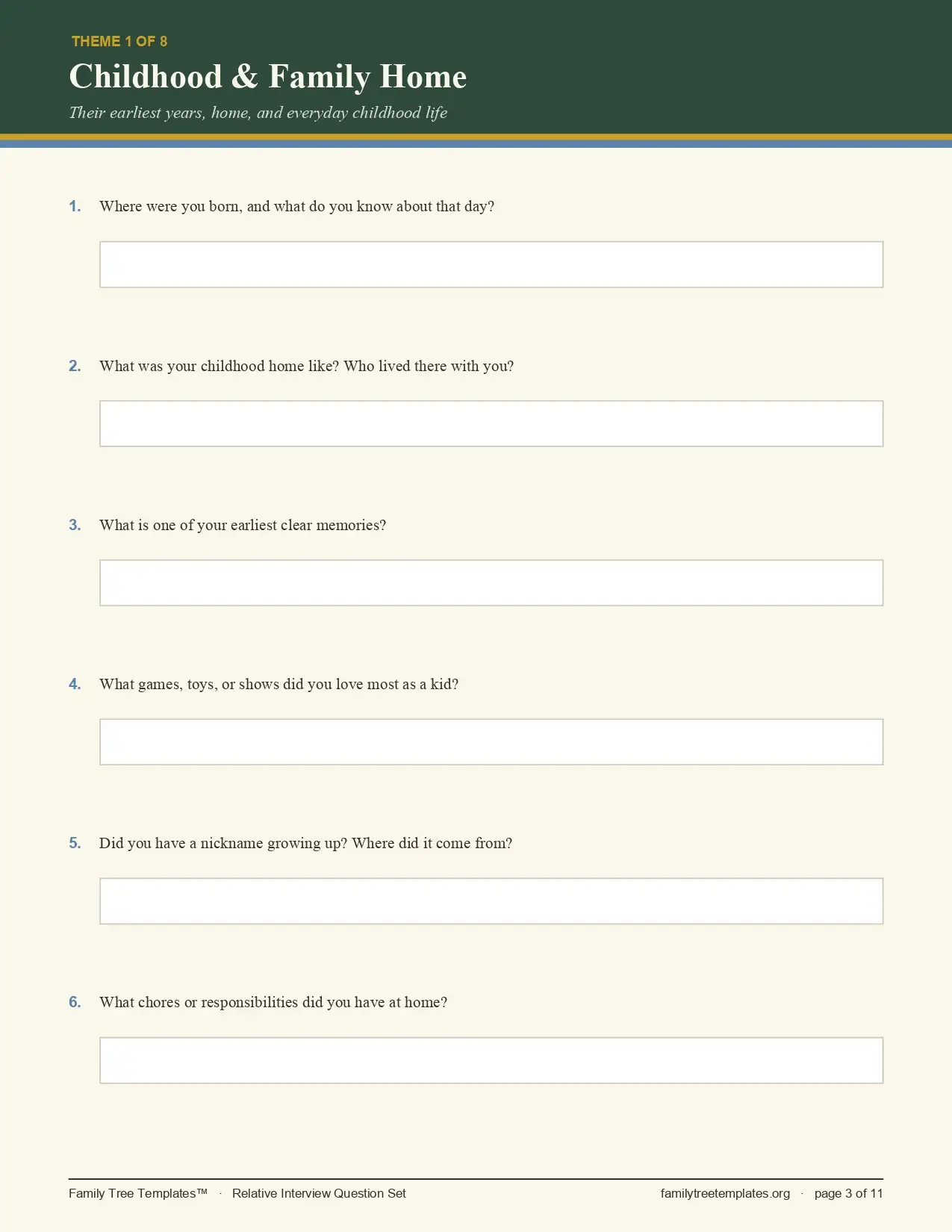
Each theme has 6 questions and its own page, with room underneath every question to write a short answer. Here's one sample question from each theme, so you know what to expect before you download.

1. Childhood & Family Home

Their earliest years, home, and everyday childhood life.

"What was your childhood home like? Who lived there with you?"

2. Parents & Grandparents

The people who raised them, and the ones before that.

"What do you remember about your grandparents?"

3. School Days & Friends

Growing up outside the house, and the people who shaped that time.

"Was there a teacher or mentor who made a lasting impression on you?"

4. Love & Marriage

How their own family began.

"How did you meet your spouse or partner?"

5. Work & Daily Life

How they spent their days and what the work meant to them.

"What job or accomplishment are you most proud of?"

6. Historic Events & Community

The wider world they lived through, and the place they called home.

"How did your town or neighborhood change over the years?"

7. Traditions & Heritage

What was passed down, and what they hope keeps going.

"Are there any recipes or dishes that have been passed down in the family?"

8. Reflections & Wisdom

The bigger picture, in their own words.

"What do you want future generations to know about you?"

That's 8 sample questions. The free Relative Interview Question Set has all 48, along with the Interview Details, Before You Begin, and Session Log pages that hold the project together.

Getting ready before you press record

A few things help more than they seem like they would. Ask permission first, even with close family; a simple "would you be up for me recording our conversation?" is enough, and the Interview Details page has a spot to note that consent.

Bring a photo or two, or a copy of what you have of the family tree so far. It jogs memory faster than a bare question does. And start with an easy, low-stakes theme, Childhood or School Days work well, before moving into heavier ones like Reflections & Wisdom.

If a relative has memory difficulties, focus on feelings and sensory details over exact dates. They tend to hold on longer, and a warm conversation is worth more than a complete timeline.

Newsletter

Get one editable Family Tree Template at no cost

Subscribe to the newsletter and get one editable Family Tree Template by email at no cost.

Etsy shop

Looking for more genealogy templates?

Browse the Etsy shop for editable family tree charts and other printable genealogy templates.

Frequently asked questions

How many questions are in the Relative Interview Question Set?

The template has 48 questions organized into 8 themes, 6 questions per theme, moving from lighter topics like childhood memories toward deeper reflections at the end.

Do I need recording equipment to use this template?

No. The Interview Details page has a spot to mark whether you used audio recording, video recording, written notes only, or a video call. A phone's voice memo app is enough for most interviews.

Should I ask every question in order?

Not necessarily. Treat the printed questions as a starting point rather than a script. The follow-up question you didn't plan is often where the best material comes from.

How long should one interview session last?

Most people start to fade after thirty to forty-five minutes, so plan for one or two themes per sitting rather than trying to get through all eight in one visit.

What if my relative doesn't want to answer a question?

Skipping is a valid answer. Some memories are private or simply gone, and that isn't a gap you need to fill.

What do I do with the answers after the interview?

Use the closing page to note questions you want to come back to next time, along with any names, dates, or places mentioned that are worth checking against records later.

Does this template work well alongside DNA research?

Yes. A name or story that comes up during an interview is often the piece that explains a DNA match cluster you couldn't place. It pairs naturally with the Leeds Method and DNA Match Organization Tracker templates.

Is it okay to record a close family member without asking first?

No. Get a spoken or written yes before you record anyone, even close family, and note their consent on the Interview Details page.